“The Grain Trap” — Why This Year’s Good Harvest Isn’t Making Ukrainian Farmers Happy
21 July 19:37 ANALYSIS FROM
Ukrainian farmers have begun the harvest, hoping not only for a crop that promises to be decent but also that they will be able to sell the harvest at a profit—though there may be problems with that. "Komersant Ukrainian" investigated how Ukrainian farmers are harvesting.
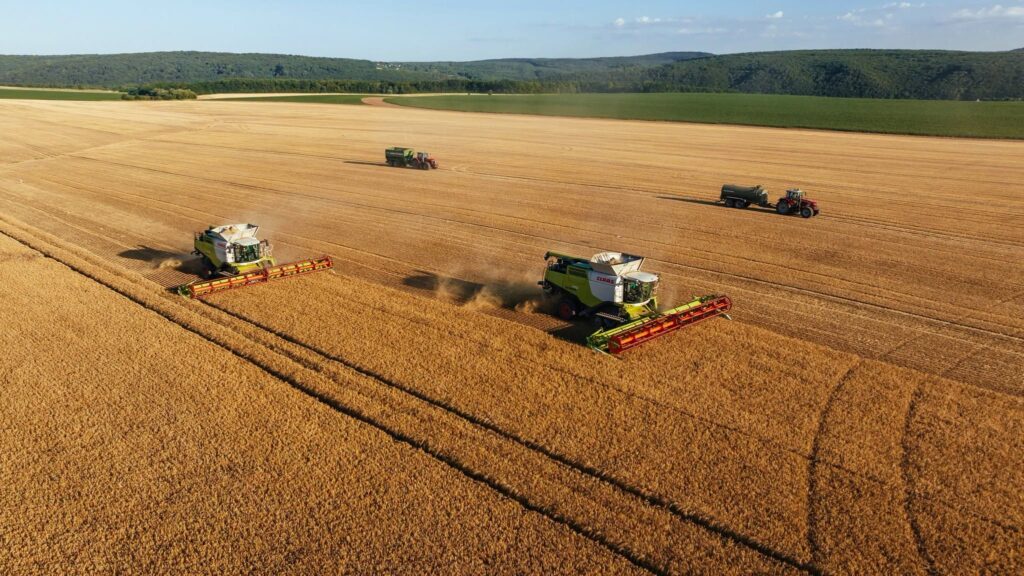
As of July 21, farmers across all regions of Ukraine had already harvested 5.47 million metric tons of new-crop grains and legumes from an area of 1.34 million hectares—that’s 11% of the projected area. Farmers in the Odesa, Mykolaiv, and Dnipropetrovsk regions lead in terms of harvest volume.
The Reality of the Harvest
This year, the harvest began earlier than usual in some regions. This was primarily due to weather conditions. Dmytro Lyudvenko, Ph.D. in Economics and a leading research fellow in the Department of Agricultural Production Economics at the National Scientific Center “Institute of Agricultural Economics,” explains :
“An early spring and accelerated plant growth triggered an accelerated development cycle for grain crops. Drought and heat stress also played a role. It should be noted that these unusual climatic conditions affected not only the traditional southern regions. Abnormal heat was also observed in the west of the country. For example, in the Lviv region, the threshing of early grain crops also began a week or two earlier due to an atypical rise in air temperature in the region,” the expert explains.
The weather may continue to affect both the harvest schedule and its results, but it’s not the only factor. According to Ruslan Khomych, owner of the “Lebedia” farm in Volyn Oblast, fuel remains the biggest problem.
“The harvest began as usual. We looked for places to get diesel on credit. We found it for 87 hryvnias per liter. The highest price for diesel here in the spring reached 115 hryvnias. What’s alarming is that the ports in Odesa are being shut down. As for harvest forecasts, I’m afraid to say anything. A lot will depend on the weather. And as long as the weather holds, we’re threshing. We’ve just started threshing rapeseed. The wheat was still a bit damp,” the farmer noted.
Oleksiy Novokhatko, a farmer from Trypillya in the Kyiv region, has already harvested his rapeseed.
“The average rapeseed yield is 35 centners per hectare. The wheat has already ripened. My personal yield this year isn’t very high. I think it’ll be somewhere around 5–6 metric tons per hectare—so it won’t be much. The spring frosts set it back a bit,” the farmer noted.
At the “Chaika-2” farm in the village of Zgurivka, winter barley has also already been harvested. Farm manager Oleksandr Chubuk offered this assessment of the harvest outlook.
“The harvested winter barley is for domestic use, for livestock. In the spring, it was in such poor condition that we wanted to replant it. But we left it, and it’s yielding about 4.5 metric tons per hectare. So the yield is normal. We checked the wheat—it should yield about 7 metric tons. I can see that there will be a sunflower harvest this year as well, provided, of course, it doesn’t burn up. The corn is looking pretty good right now, too. “So there will be a harvest, but whether it will make us happy—that’s another matter,” says Oleksandr Chubuk.
Like Ruslan Khomych, a farmer from Volyn, he is concerned about the enemy’s attacks on the ports of Odesa—this is a blow to logistics and, consequently, to prices. Oleksandr Chubuk continues:
“I’m seeing what’s happening with rapeseed among my partners in Yahotyn: the price is dropping by 300–400 hryvnias every day. Since we harvested about 1,000 to 1,500, the purchase price has dropped. This is because of the problems at the ports—the shelling. And for some reason, I think rapeseed is just a warning sign.”
Farmer Oleksiy Novokhatko also speaks about falling product prices against the backdrop of rising resource costs.
“For example, last fall wheat was selling for 10,700 hryvnias, but now it’s 8,700 hryvnias per metric ton. That’s a 20–25% drop for wheat. The difference is significant. Another key difference from last year is the sharp rise in resource prices: fuel and fertilizers. Fuel is almost twice as expensive,” the farmer notes.
Abnormal weather conditions, infrastructure and logistics problems, security challenges, and workforce reductions are the factors that are already affecting—and may continue to affect—the course of the harvest and its results. Dmytro Lyudvenko, a leading research fellow at the Institute of Agricultural Economics, emphasizes this and provides examples.
“In frontline regions, for example, crop losses on certain plots can reach 100%. Due to mobilization and migration, the number of machine operators is decreasing, and the shortage of qualified combine operators reduces the harvest speed by 10–15%. It also forces domestic farmers to rent equipment at inflated prices,” the expert notes.
But perhaps the biggest problem for Ukrainian farmers right now is the virtual halt in exports following Russian attacks on foreign vessels near Odesa. This leaves farmers with a dilemma: what to do with their harvest.
Watch us on YouTube: important topics – without censorship
The Reality of Exports
The recent enemy attacks on Odesa’s ports and foreign vessels near them have been critical for Ukrainian exports. They have effectively come to a halt. This is forcing Ukrainian farmers to adjust their plans and consider what to do with their grain. It’s also driving down prices for agricultural products. And this comes after Ukrainian farmers incurred additional expenses for fuel and fertilizers—which rose in price this spring—and had hoped to recoup their losses with the new harvest. Bogdan Kostetsky, co-owner and chief operating officer of the analytical firm Barva Invest, continues.
“This is really a double whammy for our producers. Unfortunately, when spring fieldwork was underway, oil prices skyrocketed, and then during the harvest, everything became cheaper. There was hope that the boomerang effect of inflation would drive up grain prices, but that didn’t happen.”
Current grain prices are disappointing Ukrainian farmers. And sometimes they come as an unpleasant surprise. Bohdan Kostetsky shared his observations and assessments:
“Right now, when I see the price at an elevator in Dnipropetrovsk Oblast at 5,000 hryvnias for food-grade wheat, and when I see that rapeseed has dropped in price by almost 5,000 hryvnias at the processing plants, that’s what I call an extra tug on the rope that’s about to snap. At some Ukrainian rapeseed processing plants, the price was 26,500 hryvnias a week ago; now it’s 23,000 hryvnias, and there’s a two-kilometer-long line. It looks like the plants are taking advantage of the situation—with exports shut down—to exploit the market. Although it’s worth acknowledging that they physically can’t accept any more raw materials, so they’re forced to adjust the price. But, in my opinion, this is very unfair to agricultural producers, because now they’re losing about $70 on every metric ton of rapeseed. And their reaction will be this: they’ll sell only what’s strictly necessary—for example, to pay off those same loans. In other words, I’m confident that producers will hold back and stop selling raw materials to processors.”
As Bohdan Kostetskyy explained, a meeting was held on Monday at the Ministry of Agrarian Policy. The discussion there focused precisely on how to support farmers. In particular, it was decided to assess the effectiveness of existing insurance instruments and to prepare proposals for expanding state support mechanisms and compensation for losses.
“A very difficult period may lie ahead, and this is precisely when the government needs to provide support—to allow farmers to hold out and avoid selling their grain at rock-bottom prices. Such proposals were raised at the meeting at the Ministry of Agrarian Policy. For example, there was talk of purchasing loading hoses to fill with corn. This is also intended to prevent agricultural products from being sold at low prices and to allow farmers to wait until exports resume. “Because we are now rapidly approaching the cost of production. And if we sell grain at these prices, there will be significant losses,” notes Bohdan Kostetsky.
Meanwhile, prices on international exchanges are rising. As Bloomberg reported recently, global wheat prices have risen to their highest level in two years, driven primarily by security risks affecting grain exports from the Black Sea region. Bogdan Kostetsky pins his hopes for the resumption of exports on the Turkish president.
“Recep Tayyip Erdoğan has a ‘button’ at his fingertips called the Bosphorus. Imagine a scenario where he says: until the parties sign a moratorium on shelling civilian vessels, the Bosphorus will remain closed. I think that could help. And I think that’s the only scenario under which we can hope that the sea will reopen in a few weeks or months,” the expert notes.
According to estimates by Ukrainian traders, if the problem of blocked ports can be resolved within 1–2 months, a systemic crisis in the agricultural sector should not arise, since it will be possible to export everything that is needed. However, if the delay is longer—for example, half a year—then a crisis related to a shortage of storage capacity could begin. And it’s time to start thinking about how to properly prepare for it.
Read us on Telegram: important topics – without censorship