Where Ukrainians Are Investing in 2026: Has the War Stopped Demand for Square Meters?
16 July 16:30 ANALYSIS
The Ukrainian real estate market is showing signs of a gradual recovery in the fifth year of the full-scale war. According to data from the analytical platforms LUN and DIM.RIA, prices in both the primary and secondary housing markets will continue to rise in most major cities in 2026. The most significant price increases are observed in Kyiv, Lviv, Ivano-Frankivsk, and Uzhhorod, where demand is driven by internal migration, business relocation, and a limited supply of new housing.
As a result, real estate has once again become the focus of attention not only for those looking for a home to live in but also for those seeking to preserve their capital, economists say.
How Much Will New-Construction Housing Cost in 2026?
Despite the war, prices for new construction continue to rise. Lviv remains the most expensive market; in 2026, it will even surpass Kyiv in terms of average price per square meter, according to data from Global Property Guide.
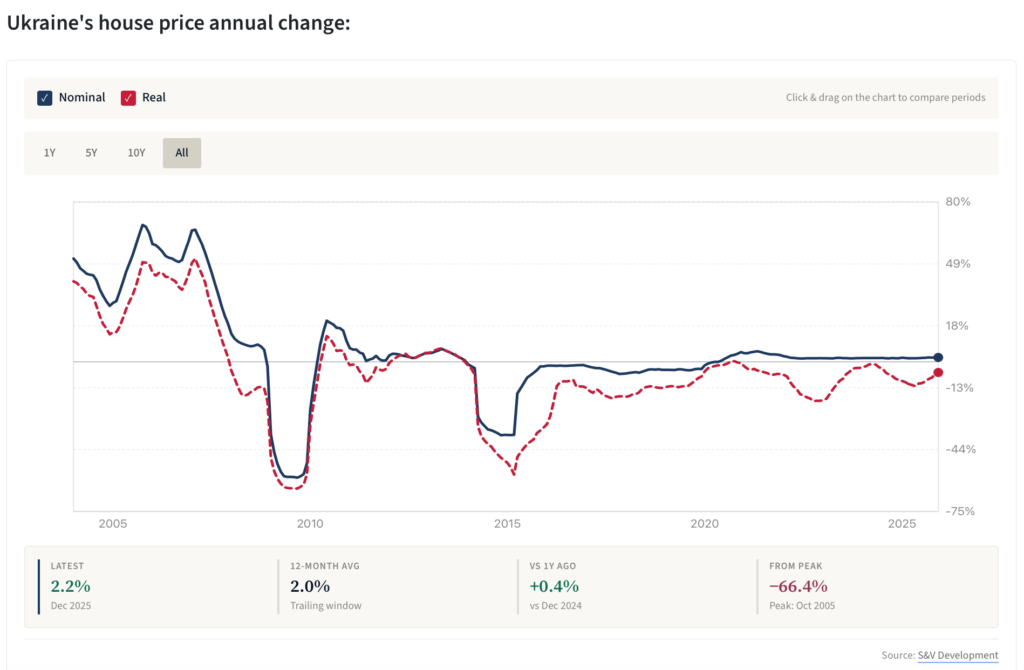
Despite the full-scale war, the Ukrainian real estate market shows no signs of a sharp drop in prices. On the contrary, most analysts expect prices to continue rising through the end of 2026 by 5–15%, depending on the region and type of housing, according to Real Estate of Ukraine.
The main drivers remain a shortage of new supply, rising construction costs, and stable demand in relatively safe regions of the country. At the same time, regional differences are becoming increasingly noticeable. Western Ukraine has effectively become a separate market with its own pricing rules, while in cities near the front lines, prices remain under pressure from security risks.
For buyers, this means that in 2026, it will be crucial not only to choose between an apartment, a house, or commercial real estate, but also to select the right city. Today, geography is increasingly determining the potential profitability of an investment.
Watch us on YouTube: important topics – without censorship
The Secondary Market Is Returning to Growth
While the secondary real estate market virtually ground to a halt in the first months of the full-scale war, it is showing a gradual recovery in 2025–2026. Buyers are increasingly opting for ready-to-move-in housing, as it eliminates the need to wait for construction to be completed and allows them to move in or start generating rental income immediately after purchase.
According to LUN, most regions of Ukraine saw an increase in both the number of transactions and apartment prices on the secondary market during the first half of 2026. Housing prices rose most sharply in cities that have become new centers of internal migration and business activity. Analysts note that buyers are increasingly preferring apartments that have been renovated, have independent heating, backup power, and buildings equipped with shelters. It is precisely these properties that sell faster and show the highest price growth.
Despite the war, price increases are observed in almost all relatively safe regions of Ukraine. The cities in the west of the country, as well as the capital, are showing the strongest growth.
The main reasons are:
- a shortage of ready-to-move-in housing;
- internal population migration;
- business relocation;
- the high cost of new construction;
- the return of investors to the housing market.
According to data from LUN and DIM.RIA analysts, apartment prices have risen the most over the past year in Lviv, Uzhhorod, Ivano-Frankivsk, and Kyiv. At the same time, prices in frontline regions remain under significant pressure from security risks.
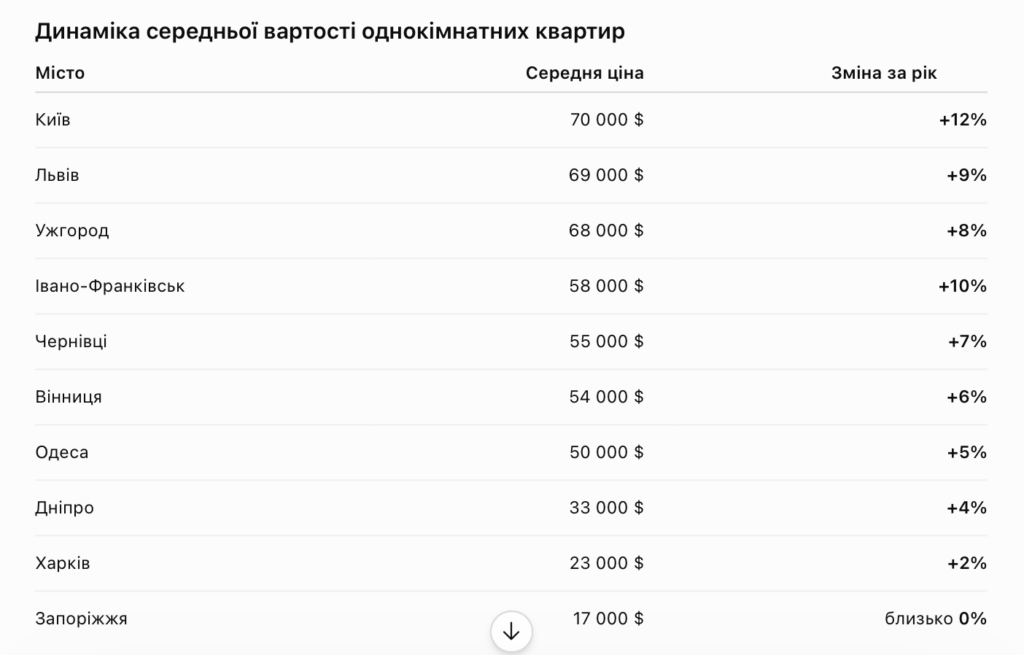
In 2026, the Ukrainian real estate market is increasingly dividing into two segments—cities experiencing active growth and cities where the security situation is holding back demand.
Lviv has remained one of the main hubs of investment activity for several years in a row. A significant influx of people, the relocation of companies, and a limited supply of new land plots are sustaining high demand for housing. That is why prices here have effectively approached those in Kyiv, and in some segments even exceed them.
Kyiv is gradually regaining its status as the country’s main market. Despite constant missile attacks, the capital remains Ukraine’s largest economic center. It is here that the largest number of high-paying jobs is concentrated, and as businesses return, demand for housing is also recovering.
Uzhhorod and Ivano-Frankivsk have become among the main beneficiaries of internal migration. Limited apartment supply, combined with stable demand, is creating the conditions for further growth in the price per square meter.
In contrast, Kharkiv, Zaporizhzhia, and, to some extent, Dnipro remain high-risk markets. Here, buyers are much more cautious when making decisions about purchasing housing, and they factor a “war risk premium” into the value of properties. At the same time, these very cities may have the greatest growth potential once the security situation improves and large-scale post-war reconstruction begins.
What Ukrainians Are Choosing to Invest In Today
In 2026, Ukrainian investors are increasingly less likely to focus on just one investment vehicle. While real estate was traditionally considered the primary means of preserving capital before the full-scale war, today it faces increasingly stiff competition from domestic government bonds (OVDP), bank deposits, and precious metals.
Each of these instruments has its own advantages and disadvantages, and the choice depends on what exactly is a priority for the investor—maximum returns, minimal risk, or long-term growth in asset value. According to economists, the current market differs significantly from the pre-war market. Whereas real estate was previously often purchased for resale upon completion of construction, today an increasing number of buyers are primarily focused on preserving capital and generating stable rental income.
At the same time, financial instruments have become much more accessible to the general public. In particular, thanks to the National Bank of Ukraine’s high discount rate, banks are offering some of the highest deposit rates in recent years, and the Ministry of Finance regularly issues government bonds with attractive yields.
Nevertheless, apartments remain one of the most popular investment vehicles among Ukrainians, even in the fifth year of full-scale war. Its main advantage is that the owner can simultaneously earn rental income and count on the property’s value appreciating in the future. According to Global Property Guide, the average gross yield on residential real estate in Ukraine is about 7–8% per year, although this figure is higher in some cities. At the same time, an apartment requires a significant initial investment, as well as additional expenses for repairs, maintenance, insurance, and taxes. Furthermore, profitability depends largely on whether the owner can quickly find tenants.
After the outbreak of full-scale war, single-family homes became significantly more popular among Ukrainians. Demand was driven by the desire to have independent housing, a private plot of land, and the ability to install generators or solar panels. However, as an investment asset, a house is less favorable than an apartment. First, it is much harder to sell due to the higher cost and smaller pool of potential buyers. Second, the costs of maintaining a house significantly exceed those of an apartment. Third, demand for private homes for rent remains significantly lower than for apartments, especially in large cities. That is why most experts believe that a house is primarily a choice for personal residence, rather than for maximizing investment returns.
For investors willing to accept a higher level of risk, commercial real estate remains one of the most attractive segments. This includes offices, retail spaces, warehouses, medical centers, coffee shops, and other properties that can generate stable rental income. According to market experts, the average yield on such assets today can range from 8% to 12% per year, which exceeds the returns on residential real estate. However, this segment is the most dependent on the economic situation. If a tenant vacates the premises, the owner may lose income for several months. In addition, commercial properties require significantly more initial capital.
Furthermore, in 2026, domestic government bonds became the main competitor to real estate. According to the Ministry of Finance of Ukraine, the portfolio of domestic government bonds held by individuals continues to grow and has already exceeded 150 billion hryvnia. This indicates that Ukrainians are increasingly viewing government bonds as a way to preserve their funds. The advantage of domestic government bonds is their high yield. In July 2026, certain hryvnia-denominated issues offered a yield of nearly 20% per annum. Another important factor is that income from OVDPs is exempt from personal income tax and the military levy, making this instrument one of the most effective for private investors.
It is worth noting that following the National Bank’s increase in the discount rate, banks also raised deposit rates. According to the UIRD index, the average rate on one-year hryvnia deposits in July 2026 was approximately 14% per annum. Despite this, deposits are less attractive than government bonds due to taxation on interest income. Furthermore, their real returns may decline due to inflation. Nevertheless, deposits remain one of the most popular instruments for Ukrainians who are not ready to invest in riskier assets.
Unlike real estate, deposits, or government bonds, gold does not generate passive income. Its main advantage lies in its ability to preserve value during global economic crises and periods of high inflation. That is why economists recommend using precious metals as one component of an investment portfolio, rather than as the sole asset.
During periods of geopolitical instability—which include the war in Ukraine—demand for gold traditionally rises; however, its value depends on conditions in global financial markets and can fluctuate significantly.
The real estate market remains a high-risk asset
However, not all experts share the optimistic forecasts regarding the Ukrainian real estate market. Economist Danylo Monin believes that despite the revival in demand, investments in real estate continue to carry significant risks.
According to him, the main source of uncertainty remains the war, which not only poses a threat of physical destruction to properties but also negatively impacts the economy, infrastructure, and investors’ long-term expectations.
“When it comes specifically to investments—as opposed to buying a home to live in—the risks remain very high at this time. This is primarily due to uncertainty regarding the duration of the war and its consequences for the economy,” Monin noted in a comment to "Komersant Ukrainian".
According to the economist, the demographic situation could become one of the key challenges for the market after the end of hostilities. A declining population and the prolonged exodus of Ukrainians abroad could dampen demand for housing even after the war ends. The expert suggests that the main demand will be concentrated primarily in the country’s largest cities and their suburbs, where jobs, businesses, and infrastructure are concentrated. In addition, regions that are relatively far from potential combat zones will remain more attractive to investors, in his opinion.
“Kyiv, its suburbs, and the western regions of Ukraine—where a significant number of internally displaced persons have relocated since the start of the full-scale war—may continue to attract the most interest,” the economist believes.
At the same time, Monin does not see any market segments that could currently be described as undervalued. In his view, the potential return on investment does not yet offset the risks posed by military and economic uncertainty. Monin believes that some Ukrainian businesses are currently taking a more cautious approach to the domestic market and are considering opportunities to invest in real estate abroad. At the same time, he says, the prevailing sentiment among private buyers is a desire, first and foremost, to preserve their capital.
Regarding the market’s long-term prospects, the economist remains cautious. He does not expect a sudden return of Ukrainians from abroad, a large-scale construction boom, or a rapid expansion of government mortgage programs. In his view, the market’s further development will largely depend on the pace of the country’s economic recovery, government policies to support business, and the creation of new jobs.
Read us on Telegram: important topics – without censorship