The Myth of “Analogovnet”: What Is Known About the Shortage and Production of Russian Missiles
4 June 18:34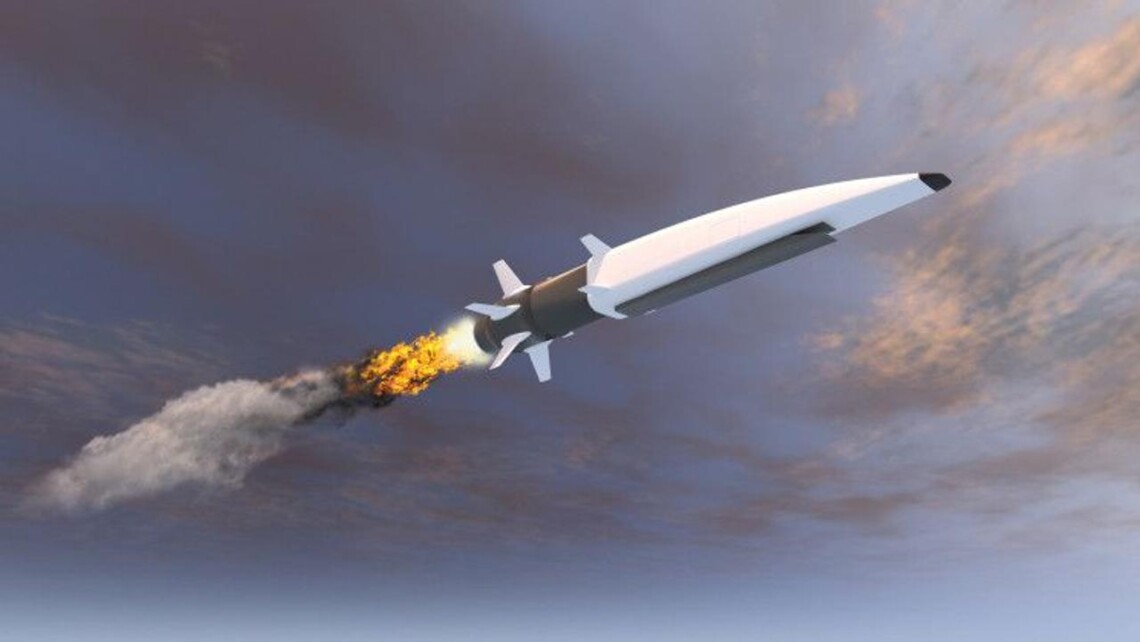
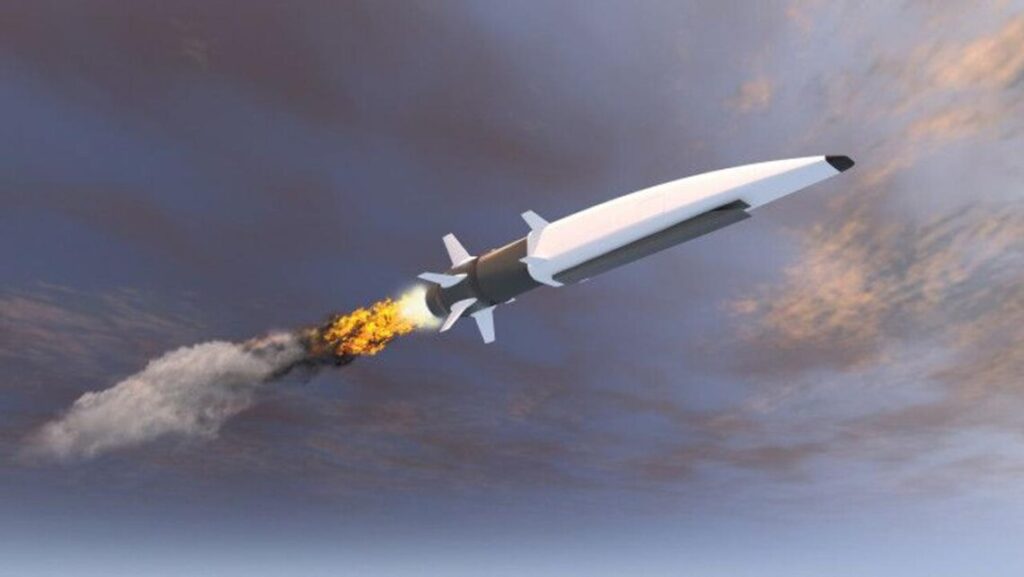
On the night of June 2, Russia launched an unprecedented attack, firing eight 3M22 “Zircon” hypersonic missiles at Ukraine. This is the largest number of these missiles fired simultaneously since the start of the full-scale invasion. For years, Russian propaganda has built up a myth around the “Zircon” as a “one-of-a-kind” weapon capable of penetrating any air defense system.
However, behind the Kremlin’s grandiose reports lie a serious shortage, technical falsehoods, and strategic impotence. What this missile actually is, why the enemy is using it to attack land-based cities, and how many such projectiles Russia is capable of producing—aviation expert Konstantin Kryvolap explained in an exclusive commentary for
Soviet Legacy: Where Did the “Zircon” Come From?
The history of Russian anti-ship missiles dates back to Soviet times. Back then, the main purpose of such weapons was to destroy large naval targets, particularly U.S. aircraft carriers.
“The previous generation had missiles called ‘aircraft carrier killers’—the Kh-22. Now the Russians have managed to modify some of them to the Kh-32 standard, improving their accuracy. The first X-22s were originally designed for nuclear warheads, where a miss of 300 meters in either direction didn’t matter at all,” explains Konstantin Kryvolap.
Later, the P-800 “Onyx” (export name: “Yakhont”) medium-range supersonic anti-ship missiles appeared, followed by their upgraded version, the “Onyx-M.” These became the technological precursors to the “Zircon.” The “Onyxes” were actively used by the enemy to strike port infrastructure in the Odesa and Mykolaiv regions and along the Danube because they fly extremely low over the water and are difficult to intercept.
The presentation of the “Zircon” itself took place during the Russian Federation’s Federal Assembly in 2018–2019, where Putin showed animated clips of the new hypersonic weapon. However, reality turned out to be far from the computer graphics.
“What Putin showed does not quite correspond to reality. It is known for certain that the first ‘Zircons’ were actually powered by conventional rocket engines, meaning they were not full-fledged hypersonic missiles. The Russians claim a maximum speed of 11,000 km/h (about Mach 9). But at the altitudes where the ‘Zircon’ flies, at that speed it would simply burn up. “There’s a lot of hype surrounding this missile,” Kryvolap emphasizes.
In 2023, despite the lack of a completed cycle of real-world tests, the “Zircon” was hastily adopted into service.
Technical Anomalies
The main contradiction of the “Zircon” lies in its intended use. The specific nature of any anti-ship missile is flight at extremely low altitudes over a perfectly flat sea surface. For example, the Ukrainian Neptune anti-ship missile is capable of flying at an altitude of just 7–10 meters above the water, adjusting to the waves.
“When the ‘Zircon’ is forced to fly over Ukrainian fields and gardens, where there is terrain, trees, and buildings, it is forced to climb to significantly higher altitudes. To do this, special programs are loaded into it or internal radio altimeters are used. In the final, terminal phase of flight, such missiles are guided using infrared radiation—the homing head ‘locks onto’ targets where there is a lot of metal,” says Kryvolap.
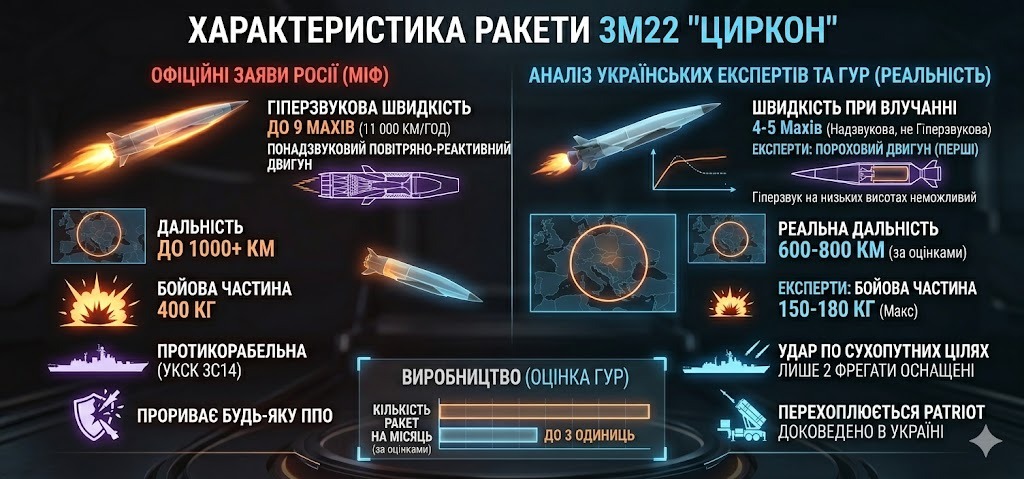
In addition, Russia significantly overstates the missile’s combat characteristics. Russian sources claim that the warhead of the “Zircon” weighs 400 kg. However, the expert notes that according to the laws of physics and aerodynamics, at the stated ranges , the weight of the explosive charge cannot exceed 150, or at most 180 kilograms.
Why “Zircons” Are Hard to Intercept and How They Strain Air Defense
Despite the technological bluff, the Zircon remains a dangerous weapon that places a colossal burden on Ukraine’s air defense system. This is especially true when the enemy combines strikes from different directions.
During massive attacks, “Zircons” are usually launched from the south, while aeroballistic missiles (such as the X-22/X-32, each carrying a ton of explosives) fly in from the north at the same time. This creates a situation where Ukrainian air defense forces must instantly cover a 240-degree sector.
“The capabilities of a single standard air defense system are limited to a 120-degree sector. Therefore, to protect a single large target—such as Kyiv—you need at least two systems, and in reality, many more. After all, some Russian missiles do not fly in a straight line; they circle, maneuver, and approach the target from unexpected directions,” explains Kryvolap.
Despite this, Ukrainian air defense has already learned to counter these missiles using Patriot systems. The first successful interception of a “Zircon” took place in early 2024. The downed missile fell in an exclusion zone near one of the Kyiv Metro lines, allowing Ukrainian experts to examine its remains in detail.
The Failure of the Naval Strategy and Actual Production Rates
An analysis of recent attacks indicates that the Kremlin’s ambitious plan for a large-scale rearmament of its fleet has completely failed.
The Russians have developed the UKSK 3S14 universal ship-based missile system. This is a vertical launch system in the form of a tube, from which various types of missiles can be launched: “Zircons,” “Kalibrs,” and “Onyxes.”
“The occupiers planned to equip a whole fleet of their frigates with these systems—about 12 ships, each of which was supposed to carry 32 such missiles. But in reality, they were only able to equip two frigates. It is these two ships that are currently hiding in Novorossiysk, Gelendzhik, or other Black Sea ports, occasionally going out to launch ‘Kalibrs’ or ‘Zirkons,’” notes Kryvolap.
The main indicator of the shortage is the production rate. According to Konstantin Kryvolap, Russia is capable of producing no more than two “Zircon” missiles per month.
Read us on Telegram: important topics – without censorship
“The Bolivar is dead”: why is Russia firing $15 million missiles?
The cost of a single “Zircon” ranges from $10 million to $15 million, according to various estimates. The use of eight such extremely expensive and scarce missiles in a single night indicates a clear targeting strategy — the enemy was attempting to strike critical infrastructure (likely key power substations and transformers), aiming to reliably penetrate Ukraine’s air defense shield.
However, the fact that Russia took this step without adding Iskander ballistic missiles to the strike indicates the progressive depletion of the enemy’s arsenal.
“This confirms my view: the Russian ‘Bolivar is dead.’ They simply don’t have enough of all this right now. If they could completely destroy our energy infrastructure, they would have done so long ago; they really want to. But they don’t have the strength,” concludes Konstantin Kryvolap.
Thus, the massive strike with eight demonstrated a shift in the Kremlin’s tactics; due to a shortage of ballistic weapons, it is forced to expend exorbitantly expensive anti-ship missiles costing up to $15 million on strikes against ground infrastructure. Given the limited production (only 2–3 units per month) and the failure of the fleet rearmament program, the use of this weapon is not a display of strength, but an act of desperation and exhaustion on the part of the Russian military-industrial complex.
Watch us on YouTube: important topics – without censorship