Long lines and sky-high prices: how Kyiv is profiting from window replacements following the shelling
27 May 13:16 ANALYSIS
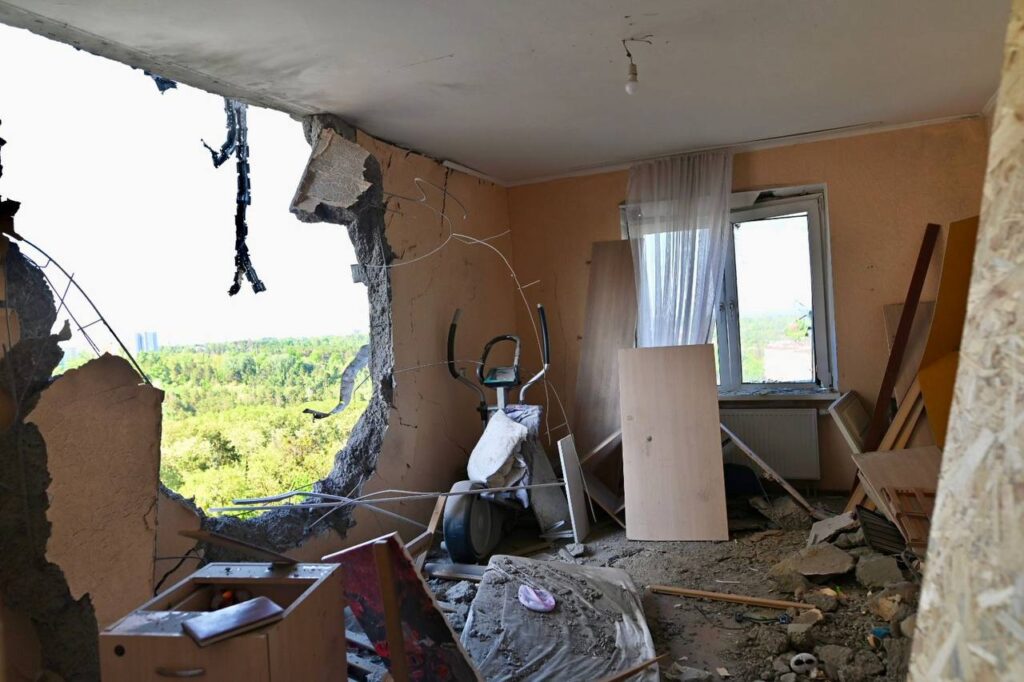
Due to the constant Russian airstrikes on Kyiv, residents of the capital regularly face the same problem—shattered windows. After a blast wave, glass shatters in apartments and houses, damaging window frames, balcony units, doors, window sills, and hardware.
Rather than waiting for bureaucratic processes to kick in and government compensation to arrive, people are trying to restore order in their homes as quickly as possible on their own. However, this forced rush has created another problem: the capital’s window market is experiencing a frenzied boom, which unscrupulous manufacturers and suppliers are actively exploiting.
Amid the frenzied demand, some companies are significantly inflating prices for the manufacture and installation of vinyl-clad aluminum structures. What’s more, even if you’re willing to pay the inflated price, getting new windows “right here, right now” is practically impossible. At most firms, waiting lists are booked weeks in advance, and in some cases, months ahead.
There are no ready-made windows: everything is made to order
Journalists checked how the window replacement market in Kyiv is functioning following the shelling and contacted several companies posing as ordinary consumers.
The company balkony-vikna.kyiv.ua explained that there are virtually no ready-made windows—all structures are custom-made to specific dimensions.
“Windows are never ready-made. They are only made to order, individually,” the company stated.
When asked how long the wait would be, the company replied: about three weeks just for manufacturing.
“It takes three weeks to manufacture a window. As for installation—those jobs are already booked up about a month in advance. We offer Rehau windows and windows from a Ukrainian manufacturer. The Ukrainian ones are a bit faster to produce, but we don’t have enough staff. After every new shipment, we get more and more requests,” the company noted.
They also explained that the price depends on the dimensions, the type of glass unit, and the manufacturer.
“As for the price—you should already have at least approximate measurements. And an idea of what kind of windows you want. Single-pane, double-pane, German, Ukrainian. All of this affects the cost,” the company added.
Waiting times—from several weeks to months
At another company—konstruktal.com.ua—journalists were told that an order for five windows would take approximately 4–5 weeks. The same timeframe applies to customers who wish to pay for the work through the “e-Restoration” program.
“It’s about a 4–5 week wait. We also work with eVidnovlennia. And it’s still 4–5 weeks, no sooner, from the time of prepayment,” the company explained.
The company euro-wikna.kiev.ua also confirmed that there are no ready-made structures in stock.
“Look, we don’t have any ready-made structures in stock. Everything is made to order,” they said.
According to a company representative, manufacturing without installation can take 5 business days, while with installation, you should expect 2–3 weeks.
“The production time, if without installation, is 5 business days; if with installation, expect 2–3 weeks,” the company explained.
Even if you need not just one or two, but 20 windows, the company assured us that the production time remains the same. At the same time, the price, as with other companies, depends on the size and configuration.
Kyiv residents complain about “astronomical” prices
On social media, residents of the capital are increasingly voicing outrage over the high prices for window replacements following Russian attacks. For many families, this has become a necessary expense that cannot be postponed.
One Kyiv resident described a typical situation currently faced by those affected:
“Today we called a contractor to estimate the cost of new windows. Yesterday, of course, we submitted an application to ‘eVidnovlennia’ due to the damage. The contractor says: expect a wait of about 6 months. I’m shocked and ask, ‘Is the waitlist that long?’ And he says the government is deliberately dragging out the process because it knows: people won’t live for half a year without windows and will eventually pay for everything out of their own pockets.”
While the government’s “e-Restoration” program processes thousands of applications, and factories can’t keep up with orders due to a shortage of materials and labor, people find themselves trapped. On the one hand, waiting is dangerous and inconvenient. On the other, a quick repair could cost significantly more than the victims expected.
Lawyer: Broken windows are not “minor repairs”
In a comment to
“Many people mistakenly believe that compensation is only provided when a house is completely destroyed. In fact, the state program also covers damaged housing. Replacing windows and doors, as well as repairs following a blast wave, can also be eligible for compensation,” the lawyer noted.
According to him, the first thing to do after shelling is to properly document the damage.
In the first few hours after an explosion, no one will install new windows. City utility services may temporarily cover them with plywood or particleboard. They usually go to the site of the incident or perform such work after a call to the hotline of the relevant utility agencies.
However, this is only a temporary measure to allow people to live in their apartments to some extent. The main task is to properly document visible and hidden damage so that you can later claim maximum compensation.
How to properly document damage
According to the lawyer, it’s not just about taking a general photo of the building. You need to take detailed photos of broken windows, damaged frames, glass shards, cracks, and other consequences of the blast wave.
“You need to document the damage immediately, as long as it’s safe to do so. Photos, videos, the date, the address, an overview of the building, and close-ups of the damage. In cases like this, there are no minor details. What seems insignificant today may become key evidence tomorrow. By the way, if you had old wooden frames, they will be replaced with plastic ones, so be sure to document everything, even if it’s from previous repairs,” explained Hennadiy Pracevityi.
After that, the homeowner should file a report on the damaged property. This can be done through local authorities, the Administrative Services Center (ASC), or the “Diya” app.
“In practice, in the first few days after the explosions, local government representatives go around the apartments and collect applications for repairs. The second most convenient option for most people is Diya. It’s not always possible to go to government offices right away, especially after shelling,” added the lawyer.
Watch us on YouTube: important topics – without censorship
Compensation does not apply to all properties
Hennadiy Pratsetvityi points out an important detail: the state compensation mechanism applies specifically to residential real estate owned by individuals.
If an apartment or private home is damaged, a person can claim compensation under the restoration program. But when it comes to a store, office, warehouse, or other non-residential property owned by a business or sole proprietor, the situation is more complicated.
“Here, we need to clearly distinguish between residential and commercial real estate. The compensation mechanism works for an apartment or a house. For an office, store, or warehouse—in most cases, it’s a different story, and you shouldn’t count on the same procedure,” explained Pracevityi.
At the same time, the attorney advises documenting damage even to businesses.
“That said, I still recommend documenting the damage and having it assessed, because after the war ends, there may be restoration or reparations funds that will operate based on evidence already gathered by businesses,” he added.
Hidden damage may become apparent later
Hidden damage remains a separate issue. After a blast wave, a window sometimes appears intact: the glass hasn’t fallen out, the frame is in place, and there are no obvious cracks. But the structure may already be deformed.
Such consequences often do not manifest immediately. In the summer, people may not notice the problem, but with the onset of cold weather, drafts, moisture, freezing, or leaks appear.
“The worst thing is to put it off until later. In a few months, it will be much harder to prove that the window’s deformation is specifically linked to a particular shelling. That’s why I always advise documenting even damage that seems minor at first glance,” the lawyer emphasized.
After submitting a claim for compensation, the property must be inspected by a commission. Based on the inspection results, an inspection report is drawn up, the extent of the damage is determined, and only then is a decision made regarding compensation.
The lawyer advises drawing the commission members’ attention even to damage that seems minor.
“It may seem like an exaggeration to you, but even a small crack in the frame can eventually lead to its complete deformation,” the lawyer explains.
Is it realistic to receive compensation?
According to Pracevity, in frontline cities, the process can be delayed due to the large number of applications, but the system itself works.
“Yes, there is bureaucracy. Yes, sometimes you have to wait. But the program really works: people receive compensation for home repairs, including window replacements. We had employees at our company who went through this process firsthand, so this isn’t just theoretical advice from an office, but practical guidance,” he noted.
The lawyer emphasizes: a broken window after an attack is not just a minor inconvenience. Often, it’s a matter of heat, safety, and the ability to remain in one’s own home.
“The main advice is simple: don’t delay. Document the damage, file a report, and wait for the commission’s inspection. The sooner a person starts this process, the better the chances of properly restoring their home and receiving compensation,” concluded Hennadiy Pracevityi.
How to Avoid the “Black Market” for Windows
Experts urge Kyiv residents to compare prices more carefully and not jump at the first “black market” offers that come along. It is especially risky to agree to work without a contract, an invoice, a certificate of completion, and a warranty.
If you have to pay for repairs out of pocket, you should still keep all documents and track your expenses. This may be necessary for future legal or compensation proceedings.
Before placing an order, you should find out:
- what kind of windows the company offers—Ukrainian or imported;
- how many chambers are in the double-pane unit;
- what type of frame is used;
- whether installation is included in the price;
- when the structure can actually be manufactured;
- When will the installation crew arrive?
- Does the company work with “eVidnovlennia”?
- whether they provide a contract and warranty.
Following the Russian attacks on Kyiv, demand for window replacements has surged. Companies acknowledge that there are no ready-made units; everything is custom-made, and lead times can range from several weeks to months. With each new wave of attacks, the number of requests increases, while manpower and materials remain in short supply.
In this situation, some of those affected are forced to pay out of pocket without waiting for compensation. At the same time, lawyers remind us: replacing windows after a blast wave may be eligible for compensation if the property in question is residential real estate owned by an individual.
The key is not to delay, to properly document the damage, file a report, wait for the commission’s inspection, and not agree to questionable offers without documentation.
Read us on Telegram: important topics – without censorship