Global Hantavirus Outbreak: Is There a Risk for Ukrainians?
8 May 12:54 EXPERT
Following reports of a hantavirus outbreak on a cruise ship, global attention has turned to this disease. The condition in question is hantavirus cardiopulmonary syndrome, which can be severe; however, the risks for Ukraine are currently considered low. In an exclusive comment to "Komersant Ukrainian", epidemiologist Natalia Vinograd explained: this type of hantavirus is associated with certain rodent species that are native to the American continent, not Ukraine.
According to the WHO, hantavirus infection is usually transmitted to humans through contact with the urine, feces, or saliva of infected rodents. Human-to-human transmission is rare and has been documented primarily for the Andes virus, which is prevalent in the Americas. The WHO assesses the risk to the global population from the current outbreak as low.
Mortality rate up to 50%: what is hantavirus
Hantaviruses are a group of viruses whose natural hosts are rodents. Different subtypes of these viruses circulate in various parts of the world. Some are associated with Europe and Asia, while others are associated with the Americas.
In the U.S. and Latin American countries, hantavirus pulmonary or cardiopulmonary syndrome is well known. It can cause severe damage to the respiratory system.
According to the U.S. Centers for Disease Control and Prevention ( CDC), the Andes virus is a type of hantavirus that can cause severe respiratory illness and, unlike most hantaviruses, can sometimes be transmitted from person to person through close contact.
Symptoms of Hantavirus
Early symptoms may resemble the flu and include:
- headache
- fever
- muscle aches/back pain
- nausea or vomiting
- diarrhea
- cough
- chest pain
- loss of appetite
- difficulty breathing
People are usually contagious only when they have symptoms.
READ ALSO: First case of “Cicada” in Ukraine: what are the symptoms of the new COVID-19 subvariant
Epidemiologist Natalia Vynohrad explains that the current reports pertain specifically to the group of hantaviruses characteristic of the American continent.
“What people are talking about now is the so-called hantavirus cardiopulmonary syndrome. This is a subgroup of viruses belonging to the hantavirus family that is spreading on the American continent. Because hantaviruses are divided into two groups—the New World and the Old World. One group is found on the Asian and European continents, and the other group is found on the American continent,” explained Natalia Vynohrad.
According to her, the distinctive feature of hantaviruses lies in their association with specific rodent species.
“This is because hantaviruses are zoonotic diseases; they have evolved to target specific rodent species. If those rodents are present, then a hantavirus could potentially be there,” noted the epidemiologist.
Could such a hantavirus be native to Ukraine?
Natalia Vynohrad emphasizes that hantavirus cardiopulmonary syndrome, which is currently being discussed in connection with the outbreak, is not a naturally occurring disease in Ukraine.
“That cardiopulmonary syndrome found in America cannot be a naturally occurring disease here because we simply do not have those rodents in our territories. And they have a very narrow specialization; they are tied to a very narrow genus of rodents,” she explained.
In other words, according to the expert, for the sustained natural spread of such a virus, the specific rodent species with which the virus is evolutionarily linked are required.
Watch us on YouTube: important topics – without censorship
Is it possible for the virus to be introduced into Ukraine?
The epidemiologist does not rule out the possibility of a single case being introduced if an infected person arrives in Ukraine. However, she emphasizes that most hantaviruses are not transmitted between people through the air.
“Introduction could occur if people who are currently infected were to arrive, because among the hantaviruses that cause cardiopulmonary syndrome, there is a virus called And, sometimes spelled Andes, which is transmitted from person to person. Because hantaviruses generally are not transmitted through the air from person to person, meaning that even if a person is sick, they do not pose a danger to those around them,” said Natalia Vynohrad.
The WHO also notes that person-to-person transmission has been described specifically for the Andes virus and remains atypical. When it does occur, it is usually associated with close and prolonged contact, particularly among family members or intimate partners.
Why is the Andes virus mentioned?
According to Natalia Vynohrad, the Andes virus is the exception among hantaviruses because it can be transmitted between people.
“The exception is the Andes virus. It is a virus that is widespread in Latin America and the United States, and it is actually linked to the outbreak on the cruise ship,” the epidemiologist noted.
The CDC also identifies Andes as the only type of hantavirus known to be transmitted from person to person. However, such transmission is typically limited to people who have had close contact with an infected individual.
Is there cause for panic in Ukraine?
When asked if there is currently cause for panic in Ukraine, Natalia Vynohrad replied that there is no such danger at this time.
“The WHO assesses the risks as low,” the epidemiologist emphasized.
This assessment is also confirmed by the WHO’s statement regarding the current cluster of hantavirus infection: the risk to the global population from this event is currently considered low, and the situation is being monitored.
What Ukrainians need to know
Current reports on hantavirus do not signal the start of a new pandemic. The WHO emphasizes that hantaviruses do not spread like COVID-19, and cases of human-to-human transmission of Andes are associated with close and prolonged contact.
For Ukraine, the key point is that American hantavirus cardiopulmonary syndrome has no natural reservoir on our territory due to the absence of the relevant rodent species. At the same time, as with any infectious risks, epidemiological surveillance, monitoring of imported cases, and timely medical consultation remain important if symptoms appear after traveling to high-risk regions.
Why are hantavirus infections dangerous?
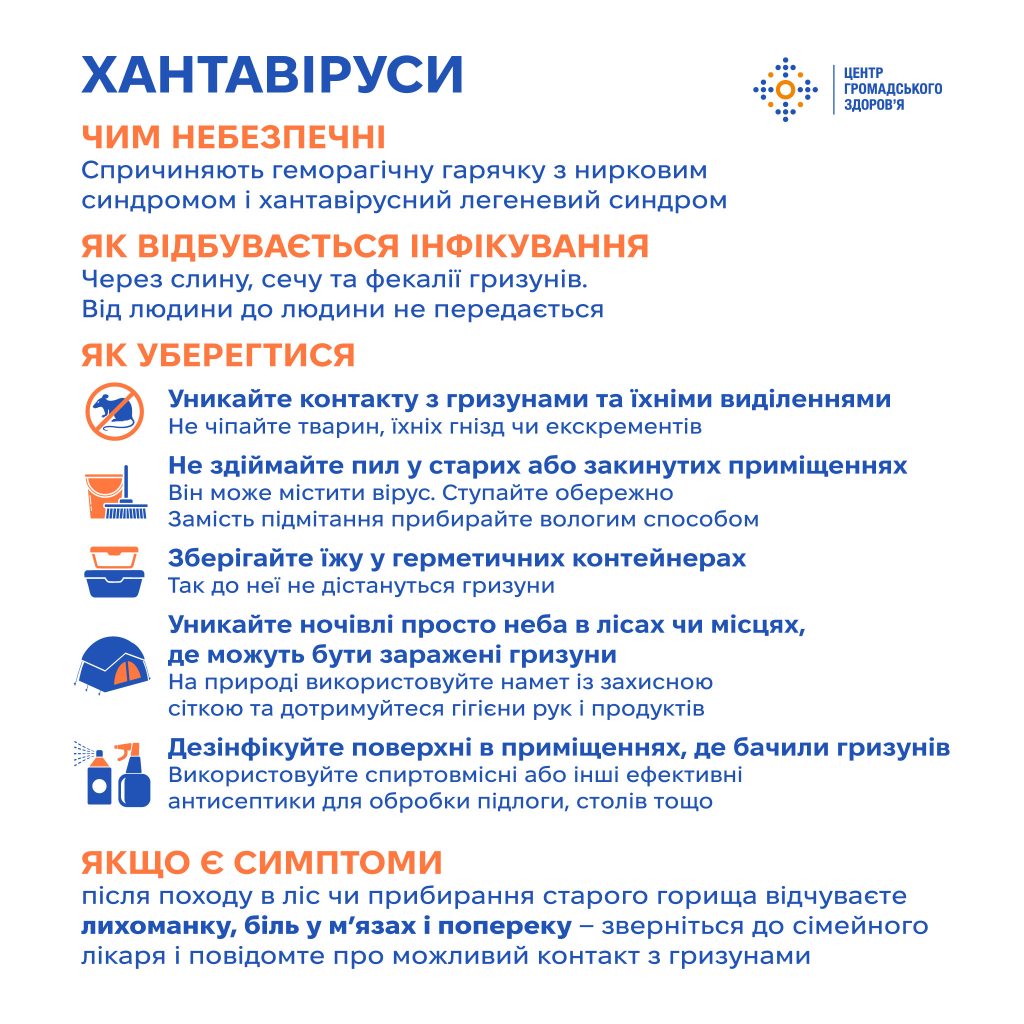
As previously mentioned, hantaviruses can cause two serious diseases in humans: hemorrhagic fever with renal syndrome and hantavirus pulmonary syndrome. Both of these diseases are severe and require immediate medical attention.
Hemorrhagic fever with renal syndrome (HFRS) begins with a sudden rise in temperature, severe weakness, muscle pain, headache, and eventually, kidney dysfunction. Hemorrhagic syndrome may occur (nosebleeds, hemorrhages in the sclera, skin rashes due to damaged capillaries). In severe cases, acute renal failure sets in. The patient may end up in intensive care and require hemodialysis.
In Ukraine, isolated cases of HHS have been reported over the past decade.
Hantavirus pulmonary syndrome (HPS) begins like a cold or the flu: with fever, cough, and body aches. But within a few days, the condition deteriorates rapidly—shortness of breath, pulmonary edema, and respiratory failure set in. Without timely treatment, the disease can be fatal.
How to protect yourself from hantavirus
- Avoid contact with rodents and their excretions.
Do not touch the animals, their nests, or their droppings. - Do not stir up dust in old or abandoned buildings.
It may contain the virus. Tread carefully. Use a damp mop instead of a broom. - Store food in airtight containers. This will keep rodents from getting to it.
- Avoid sleeping outdoors in forests or areas where rodents may be present.
When outdoors, use a tent with a protective mesh and maintain good hand and food hygiene. - Disinfect surfaces in areas where rodents have been seen.
Use alcohol-based or other effective antiseptics to treat floors, tables, and other areas where animal secretions may have been present.
What to do if you have symptoms of a hantavirus infection
If you develop a fever, muscle pain, or lower back pain after a hike in the woods or cleaning out an old attic, contact your family doctor and report any possible contact with rodents.
Read us on Telegram: important topics – without censorship